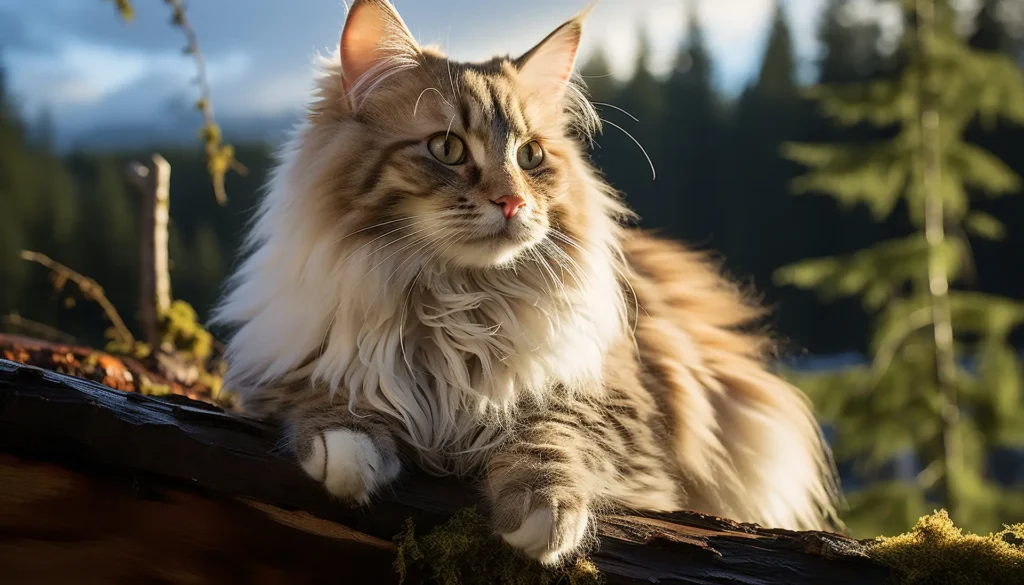

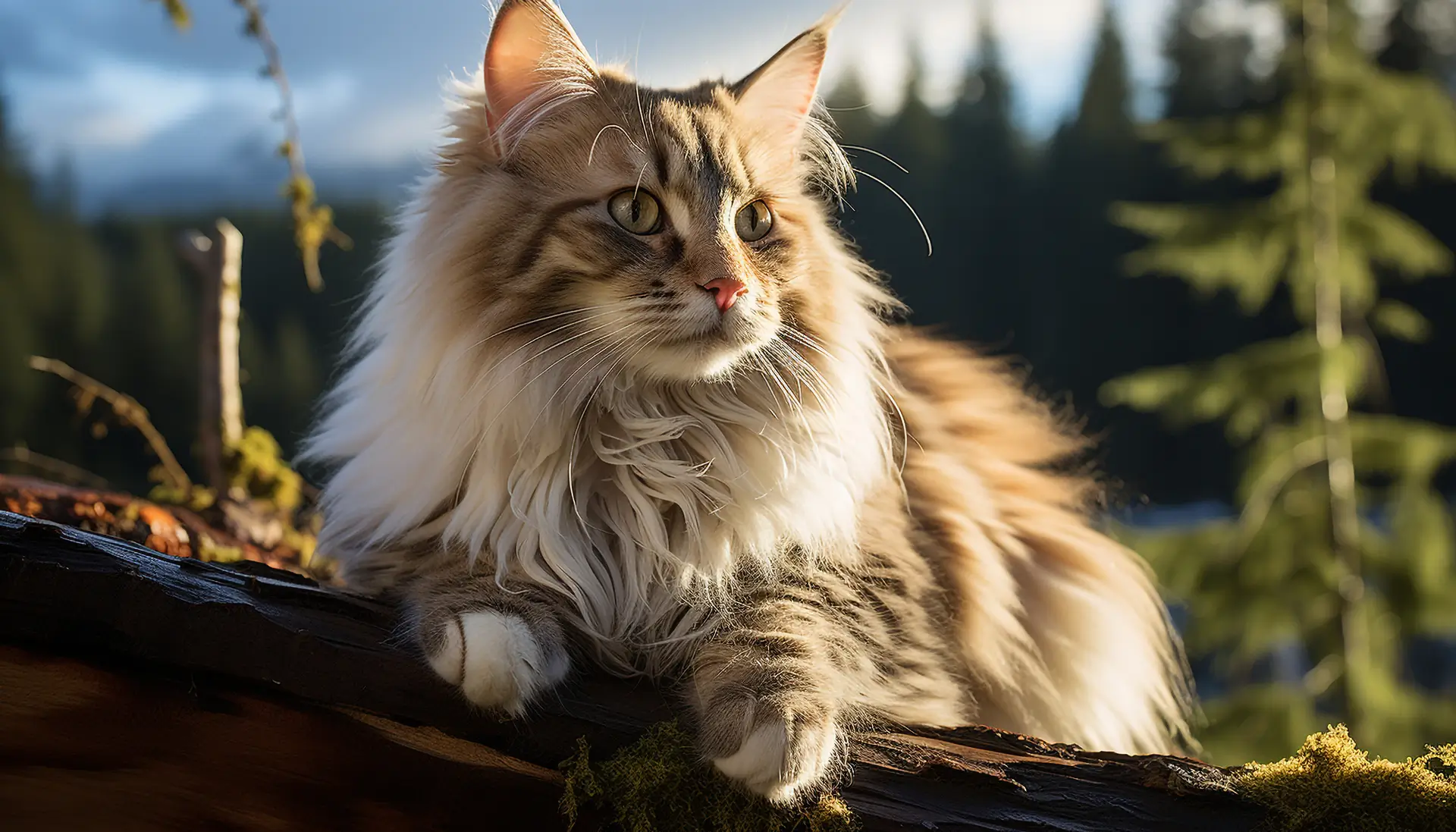
The Norwegian Forest Cat lived in forests for a long time. It had to handle cold winters and rough land. The Norwegian Cat is an animal. It is not supposed to look nice. The Norwegian Cat is good at staying alive. This is because the Norwegian Forest Cat had to be strong to live in the forests. The winters are cold. The terrain is rough. The Forest Cat had to be strong to survive in these forests. The Cat is very good at surviving.
In Norway, people call the Cat the skogkatt. That is what they say in Norwegian when they mean Norwegian. There is nothing about the name. The Norwegian Cat has a coat that keeps it dry in water. Its back legs are super strong. This cat is built for climbing trees.
The Norwegian Forest was named Norway’s cat by King Olav V in the 1950s. Before that, it was in Norse stories. The Norwegian t was there, with Freya. People think the Norwegian Forest Cat traveled on ships. It helped get rid of mice on boats. It was not a pet then. The Cat was just working.
Personality of a Cat
Most people come in expecting large and lazy. Large is accurate. Wegies want to be near you, not on you. They claim the arm of the couch, not your lap. They appear in doorways when something’s happening and quietly disappear when it isn’t. People who get ready for a Norwegian Forest Cat are often surprised. The Forest Cat will just walk over to see who the new people are.
The Cat is really smart. This means the Norwegian Forest Cat needs something to keep it busy. Clicker training holds their attention. Harness walks work well. Some will fetch.
Voice is quiet. Chirps and trills mostly. Not the breed that wakes you up at 5 am because the bowl is half empty. The loyalty is consistent and unannounced, no grand gestures. The cat does not go away. I mean, the cat just stays nearby all the time.
Norwegian Forest Cat Size and Physical Traits
Males run 12–16 pounds, occasionally past 19. Females are usually 8–12. Long-bodied and muscular, built more for climbing than sprinting.
The hindquarters are noticeably strong. Wegies come down trees headfirst, which other Norwegian Forest Cats don’t do. If you have not seen a cat before, it looks weird when you see it for the first time. The coat of the cat is made up of two layers: an undercoat and a long outer layer that is glossy and does not let water in.
The colors of the cat are many: you can see white, black, red, cream, silver, and gold on the cat. These colors can be solid. They can be, in tabby, calico, or tortoiseshell patterns. The eyes of this thing are really nice. They can be green, gold, or copper.
The triangular face separates them from Maine Coons faster than anything else. The expression is steady. Focused. Not a scatterbrained cat.
Norwegian Forest Cat vs. Maine Coon
| Feature | Norwegian Forest Cat | Maine Coon |
| Weight (male) | 12–16 lbs | 13–18 lbs |
| Weight (female) | 8–12 lbs | 8–12 lbs |
| Eye shape | Almond | Round |
| Head shape | Triangular | Wedge-shaped |
| Body build | Muscular, balanced | Long, rectangular |
| Coat texture | Water-resistant | Silky, less dense |
| Maturity age | Up to 5 years | 3–4 years |
| Origin | Norway | Maine, USA |
Both breeds are big and have a nature they are also good with families. The Wegie has a build and a pointier face. The Maine Coon is longer and has eyes that are more rounded. It also looks more open and friendly. The details are similar.
Norwegian Forest Cat Grooming
The coat looks high-maintenance. It mostly isn’t. The texture resists tangling, so one session a week handles things for most of the year.
Spring is different. When the winter undercoat grows in, you need to brush it every day. This needs to be done for two to three weeks. You can use a wide-tooth comb for this.
You can use a slicker brush to brush the winter undercoat. The important thing is to work from the skin of the winter undercoat. This helps a lot with the winter undercoat. The ears and backs of the legs mat first, catch it early, and it’s nothing, leave it, and it becomes a whole thing the Norwegian Forest Cat won’t forgive quickly.
Baths are rarely needed. The water-resistant coat sheds most dirt on its own. Nails every few weeks, ears once a month, teeth as often as you can manage. Dental disease is common in all Norwegian Forest Cats, and brushing actually makes a difference over time.
Health Problems
Pedigreed Norwegian Forest carries inherited risks. Norwegian Forest Cats have several worth knowing before you buy.
Hypertrophic cardiomyopathy (HCM): The heart wall gets thicker as time goes by. In Norwegian Cats, a common heart issue is when the heart wall gets too thick. Often, these cats do not show any symptoms until the problem is far along. To catch this problem early, your best bet is to have heart check-ups.
Glycogen storage disease type IV (GSD IV): Rare. It can be deadly, and there is no treatment. You must get test results from the breeder. Ask for them every single time.
Hip dysplasia: Cats that are heavier often have pain. This pain is usually quite bad. Heavier cats tend to have stiffness. The joint pain and stiffness in these cats are really noticeable. Cats, with weight, seem to suffer from joint issues. Heavier Norwegian Forest Cats have a lot of trouble with pain and stiffness. Weight management is the main lever you have.
Diabetes mellitus: this breed gets diabetes at three and a half times the rate of the cat. That is bad news. You can actually help your cat by doing two things. Feed them a diet and keep them active from a young age. If you do these two things, it can lower your chances of getting diabetes. It is good to take care of your cat so they do not get diabetes.
Pyruvate kinase deficiency: The red blood cell count issue is something that people notice when their child is three years old. Manageable with monitoring.
Forest Cat Health Conditions and Recommended Preventive Care
| Health condition | Risk level | Action |
| Hypertrophic cardiomyopathy | Moderate to high | Annual cardiac screening |
| Glycogen storage disease IV | Low, rare | Breeder genetic testing |
| Hip dysplasia | Low to moderate | Weight management, vet checks |
| Diabetes mellitus | Moderate | Diet control, regular vet visits |
| Pyruvate kinase deficiency | Low | Blood tests if symptoms appear |
A breeder who won’t provide health documentation isn’t worth working with.
Price
Expect to pay $800–$1,500 from a responsible breeder. Show-quality Norwegian Forest Cats from champion bloodlines usually cost more. That price reflects health testing, documented lineage, and the real expense of raising a healthy litter, not inflated markup.
Adoption or rescue usually costs between fifty dollars and two hundred dollars. It often includes vaccinations and spaying or neutering surgery. Finding a Wegie through rescue can take a while. It is a good option if you are not looking for a kitten.
Long-term costs matter too. Food for my cat usually costs twenty dollars to forty dollars every month. The flea prevention medicine costs another ten dollars to twenty dollars. Then I also have to think about the money for vet visits and grooming supplies. A good cat tree for Norwegian Forest Cats like mine costs eighty dollars to two hundred dollars. Honestly, I really need one of these cat trees. My Norwegian Cat loves to climb, so my cat needs lots of space to move around. It is not an extra thing to buy; it is actually part of taking good care of my Norwegian Forest Cat.
Is This Breed Right for You?
Works well for types of homes like families, single people, and houses with dogs. This dog does okay on its own, so it is good for people who work time and cannot be home all day.
The outdoor instinct is real. Indoor-only is fine, but the energy needs somewhere to go: Norwegian Forest Cat trees, window access, and daily play. Skip those, and you’ll know it. Spring shedding is heavy. The cat loaf position happens when a cat tucks its paws underneath its body while resting.
One fair thing to say is that if you want a cat that fits into your life without asking for a lot, this breed is a good pick. If you want a cat that’s more fun and likes to play with you, a cat that follows you everywhere, and has lots of thoughts about things. A Maine Coon is probably the way to go. The thing is, you cannot say one is better than the other because it is all about what you want from a cat, like a Maine Coon.
Conclusion
The Norwegian Forest Cat wasn’t bred toward anything. Nature shaped it over centuries, and that still shows in the way it moves, the way it holds itself, the way it doesn’t particularly need your approval.
Ownership does ask something of you. When it comes to a Wegie, grooming is something you have to think about during shedding season. None of this is too much to ask for. Compared to breeds that need to be entertained all the time or make a lot of noise in your apartment, a Wegie is really easy to live with once you have the basics covered for your Wegie.
FAQ
Are Norwegian Forest Cats good with dogs?
They’re calm and confident, so they assess new dogs instead of panicking. Gradual introductions help. The harder pairings are small, high-energy dogs that push past obvious signals; that’s less about the cat and more about the dog.
Good for first-time owners?
Yes. The cat’s temperament is steady. Its grooming is manageable. The cat’s personality is also very stable. It does not change suddenly. One thing that people always get wrong is that they do not think about space and daily play for the dog. Sort those out early, and the rest of it comes naturally.
Can they live in apartments?
Yes, if the space is set up right. Height matters more than square footage; a tall cat tree or wall shelving makes a real difference. Daily interactive play is very important for this reason. It helps to keep the energy of interactive play in check.
Do they get along with other cats?
Generally well. Not pushy, not territorial. Standard gradual introductions, separate rooms, scent swapping before any face-to-face, smooth things out considerably. Most multi-cat households settle once everyone finds their spot.