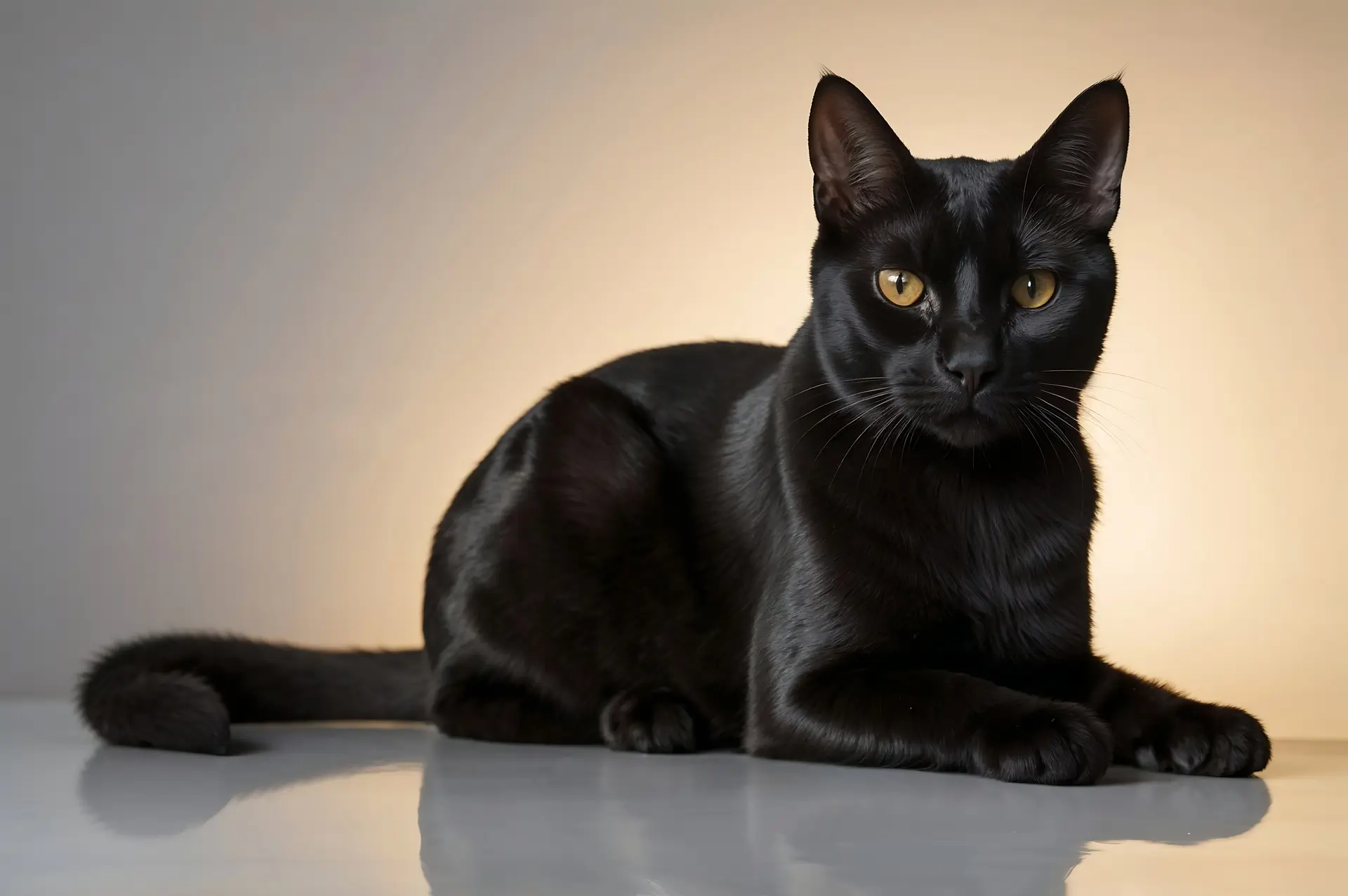
Spend a few minutes with a Bombay cat. You will see why people get a little strange about them. The fur catches your eye first. It is pure black. Shines like it has been polished. It looks too perfect, like the shiny topcoat, on a piece of furniture. The cat’s black coat is really beautiful. People love their looks.
The eyes are copper, sometimes burning almost orange, depending on the light, and they fix on you with complete attention. Your brain runs the obvious wild cat comparisons. Then the animal trots over, head-bumps your leg, and settles directly onto your feet. That’s it. Looks like a predator, acts like a throw pillow with opinions.
The History and Origin of the Bombay Cat
Most cat breeds weren’t planned. Nikki Horner’s was. A Louisville-based breeder, she went into the 1958 breeding season with a clear goal: to produce a domestic cat with the look and movement of a small black leopard cat. She crossed a sable Burmese female with a black American Shorthair male.
The first generation didn’t deliver what she wanted. She refined the approach and tried again, then again. By 1965, she had her cat’s, solid black coat, heavy frame, copper eyes, and that distinctive rolling stride. The Cat Fanciers Association gave recognition to the breed in 1970. TICA followed suit nine years later. Then the breed remained little known, mostly seen in cat shows and in homes that were lucky to have one.
American Bombay Cat vs British Bombay Cat
Most guides skip this part, but it matters. Two separate Bombay lines exist, developed independently, and they differ in at least one obvious way. The American Bombay cat is Horner’s creation, a sable Burmese crossed with a black American Shorthair. Eye color runs from rich gold through to deep copper.
The British Bombay was developed separately in the UK, using European Burmese crossed with black domestic shorthairs, and British lines often carry golden or green eyes rather than copper. That surprises people who were expecting only one look. Coat and temperament are the same between them. In the US, the American version is what you’ll almost certainly encounter.
Breed Comparison
| Feature | American Bombay | British Bombay |
| Eye Color | Copper or Gold | Gold or Green |
| Ancestry | Burmese + American Shorthair | Burmese + British Shorthair |
| Registry | Cat Fanciers’ Association, The International Cat Association | Governing Council of the Cat Fancy |
| Availability | More common | Rarer |
| Build | Muscular, compact | Slightly refined |
What Does a Bombay Cat Look Like
Black is the color here, and it goes all the way through. There is no base, no hidden ghost tabby pattern.
The fur lies flat and close to the body. It catches the light around. Reflects it. This makes it look like shiny material, rather than a real animal coat.
The nose leather of the cat is black. The paw pads of the cat are also black. The whiskers of the cat have shading on them. The eyes of the cat are really big and round. They are set into a head that is also round. The color of the eyes of the cat changes when the light hits them; it goes from a yellow-gold to a deep copper color that can look almost orange.
The weight of the cat often surprises people who pick it up. The cat looks like it is a size, but it feels really heavy. The males of the cat are usually more than 12 pounds. The females of the cat are usually between 8 and 12 pounds. They feel solid and muscular. When the cat of this breed walks away, it often moves from side to side, which is a distinctive way of walking that makes people look at the cat again.
Physical Traits
| Trait | Detail |
| Coat | Short, glossy, jet black |
| Eye Color | Copper to gold |
| Weight (Male) | Over 12 lbs |
| Weight (Female) | 8–12 lbs |
| Body Type | Muscular, compact, round |
| Nose and Paw Pads | Solid black |
| Walk | Slight sway |
Bombay Cat Personality and Temperament
Everything about Bombay’s personality contradicts its appearance. A cat engineered to look like a miniature predator probably should be aloof, selective, and a little intimidating. Instead, it follows you to the kitchen to supervise breakfast. It sits on the bathroom counter while you get ready. It settles into your lap the moment you stop moving and treats that arrangement as permanent until further notice. The phrase “velcro cat” comes up constantly among Bombay owners because it’s the most accurate shorthand available.
The temperament draws from both parent breeds. The American Shorthair side contributes steadiness and a calm adaptability. The Burmese side brings a focused social intensity, a genuine need to be near and engaged with people.
Put those together, and you get a cat that handles strangers easily, tolerates kids without drama, and treats your presence as the most interesting thing in any given room.
Multi-pet households are workable. Dogs sort themselves out with gradual introductions. Other cats require more patience, since Bombay cats naturally assume they hold senior rank and act accordingly from day one.
Fetch is something many of them develop without any deliberate training. Leash walking suits a surprising number of them. Tricks land quickly because these cats are paying attention, and the best food for cats is. Leaving one alone all day without stimulation or company is an experiment most owners only run once.
Bombay Cat vs Regular Black Cat
Plenty of black cats get misidentified as Bombays, and the confusion is understandable from a distance. Up close, the tells are consistent. Coat texture is the first: Bombay’s fur has a reflective quality that most ordinary black cats simply don’t produce, regardless of condition. Eye color is the next, copper or gold; those are the only options.
Any cat showing green, pale yellow, or amber-hazel eyes is not this breed. Head shape adds another layer. The Bombay carries a noticeably round skull, wide across the face, with a heavier bone structure than a typical domestic cat. Add the swaying stride, and the picture gets clearer. Still uncertain? A reputable breeder can walk you through the physical standards. A pedigree is ultimately the only confirmation that holds up.
Grooming Your Bombay Cat
The Bombay cat does not need a lot of grooming, which is surprising because they look so nice and clean. Their fur is short and close to their bodies, so it does not shed much. You only need to brush them with a brush about once a week.
Cats are very good at keeping themselves clean, so when you do brush them, they are already pretty clean.
There are some things that you need to help your Bombay with. You need to brush their teeth a few times a week because if you do not, they can get a disease. You also need to trim their nails every couple of weeks.
You should check your cat’s ears every week. Clean them if they have too much wax in them. Some Bombay cats get a bit of discharge in their eyes, so you should wipe under their eyes with a damp cloth every day to keep them clean.
Diet and Nutrition for Bombay Cats
Food is not something Bombayis are indifferent to. This breed loves to eat. Will keep eating even when they are not hungry anymore. This makes feeding not a good idea for many homes. Scheduled meals help you control how much they eat. It also helps you notice if they do not want to eat as much as usual. Kittens eat well with three meals a day. Adults manage fine on two measured meals.
So the diet should be based on protein. This is really important. Carbohydrates should be kept to a minimum.
I like to include food in the diet because it helps with hydration, and it is good for the kidneys in the long run.
Sometimes it is okay to give treats, but do not give them too often. Protein and wet food are the things treats should make up less than 10 percent of the calories that are eaten every day. Fresh water available at all times matters, especially in households where dry food plays a significant role.
Feeding by Life Stage
| Life Stage | Meals Per Day | Key Focus |
| Kitten (0–6 months) | 3 | Protein, fat, growth |
| Adult (1–7 years) | 2 | Lean protein, weight control |
| Senior (7+ years) | 2 | Joint support, kidney health |
Bombay Cat Health Issues and Lifespan
Bombay cats usually live between 12 and 16 years. It is not unusual for a Bombay cat to live into their teens if you take good care of them. The Bombay breed is pretty healthy. There are a few health issues that you should know about before you get a cat.
One big health issue is something called cardiomyopathy. This is when the heart muscle gets thicker, and it does not pump blood well. You might not even notice that your Bombay cat is sick. That is why it is an idea to get your cat’s heart checked every year when you take them to the vet.
There is another health issue that can affect Bombay kittens when they are born. It is called defects. This is something that they can get from their parents, who got it from the side of the family. Unfortunately, this health issue is usually very bad. It can be fatal for Bombay kittens.
Breeders who are doing things properly test for the causative gene variant before breeding. Hypokalemia involves low blood potassium and produces episodes of muscle weakness and appetite changes in cats carrying the relevant variant. Beyond those three, the usual applies: weight management, breathing checks for cats with flatter noses, and periodic attention to eye discharge.
Common Health Issues
| Condition | Description | Prevention |
| Hypertrophic Cardiomyopathy | The heart muscle thickens over time | Regular cardiac checkups |
| Craniofacial Defect | Facial malformation in kittens | Responsible breeding |
| Hypokalemia | Low blood potassium | Balanced diet, vet care |
| Obesity | Excess weight gain | Portion control, exercise |
| Respiratory Issues | Breathing difficulty | Monitor, vet follow-up |
| Eye Tearing | Mild eye discharge | Gentle daily wiping |
Training and Exercise for Bombay Cats
Bombay cats are easier to train than most cats, and that’s not faint praise; it’s just true. These animals pay attention. They track what’s happening in a training session, connect behavior to outcome quickly, and respond well to positive reinforcement with small food rewards. Results show up within a few sessions rather than weeks. Many develop a fetch habit with no deliberate teaching, just through repeated play with small toys.
A notable portion accept leash walking and seem to actually enjoy it.
Thirty minutes of real play daily is a reasonable minimum. Wand toys, laser pointers, and food puzzle feeders all hold their attention. Cat trees get regular use because this breed gravitates toward height and open sightlines.
Rotating toys every few days prevents the declining interest that comes with repetition. A Bombay that has lost interest in its toys will find its own entertainment, and you probably won’t enjoy what it comes up with.
Bombay Cat Breeders and Price
Sourcing a Bombay takes advance planning. Registered breeders in the United States are few, and reputable ones almost universally maintain waitlists. Six months to a year between inquiry and kitten is standard. Price ranges from $400 to $2,000. It depends on the dog’s family history and how good the breeders are where you live.
When you talk to a breeder, make sure they give you all the vet records.
They should also show you proof that the dog has all its shots.
They need to give you results from genetic health tests.
If they do not want to give you this information, it is best to look for another breeder.
Shelter adoption is another option, though confirmed mislabeling of black cats as Bombay cats happens in shelter settings. Assess coat reflectivity, eye color, skull shape, and bone density carefully before concluding.
Owners who go through this process and land a genuine Bombay tend to describe being caught off guard by how attached the cat becomes, and by how attached they end up becoming in return.
Is a Bombay Cat Right for You
The Bombay fits a wide range of living situations. Studio apartment, large noisy family home, both work. What doesn’t work is a home where the cat spends most hours alone without stimulation or company. Bombays are not subtle about dissatisfaction with that arrangement. A second animal in the household helps significantly when long working hours are unavoidable. The breed integrates well with dogs given patient introductions. Children are generally handled without drama.
Bombay Cat vs Other Popular Breeds
Visually, the Bombay invites wildcat comparisons constantly. Behaviorally, it has nothing in common with them; it’s built for indoor life and human company. Placed alongside the Persian cat, the contrast looks different. Persians are composed, quieter in their demands, and generally content to observe rather than participate.
They also need daily coat maintenance that adds up over months. Bombay needs a fraction of that grooming effort but trades it for a much higher need for engagement. Owners who want a cat that comes to find them, rather than waiting to be found, tend to prefer the Bombay.
Conclusion
The Bombay gets your attention with the coat and the eyes. What keeps you is the cat underneath, the one that follows you from room to room, installs itself in your lap without asking, and pays attention to you in a way that’s a bit unsettling until you get used to it. Grooming is easy.
Training is actually rewarding. The health concerns are manageable with regular vet attention. People who own Bombays are usually the kind of people who just love Bombays. They will talk about their Bombays all the time, even when you do not ask them to. After you spend some time with a Bombay, you will start to understand why people who own Bombays like them very much.
FAQs
How long do Bombay cats live?
Typically, cats live for 12 to 16 years. If you take care of your cat, feed it high-protein food, and keep it indoors, it can live a longer life. Many cats live into their teens, which is even older than 16 years.
Are Bombay cats good for apartments?
Space rarely matters. A Bombay in a small apartment with thirty minutes of daily play and regular human company does fine. The same cat in a large house, left alone all day, won’t. Interaction matters more than square footage.
Do cats shed a lot?
Less than most brown cat breeds. The coat is short and tight, which limits how much loose hair ends up on furniture and clothing. One brush per week is enough, and the coat stays sharp without much intervention.
Are Bombay cats rare?
Yes. Fife logged 13 Bombay kitten registrations globally across all of 2024. Registered breeders in the US represent a small community, most with active waitlists. Impulse adoption of this breed is rarely an option.